Monday, 11 April 2016

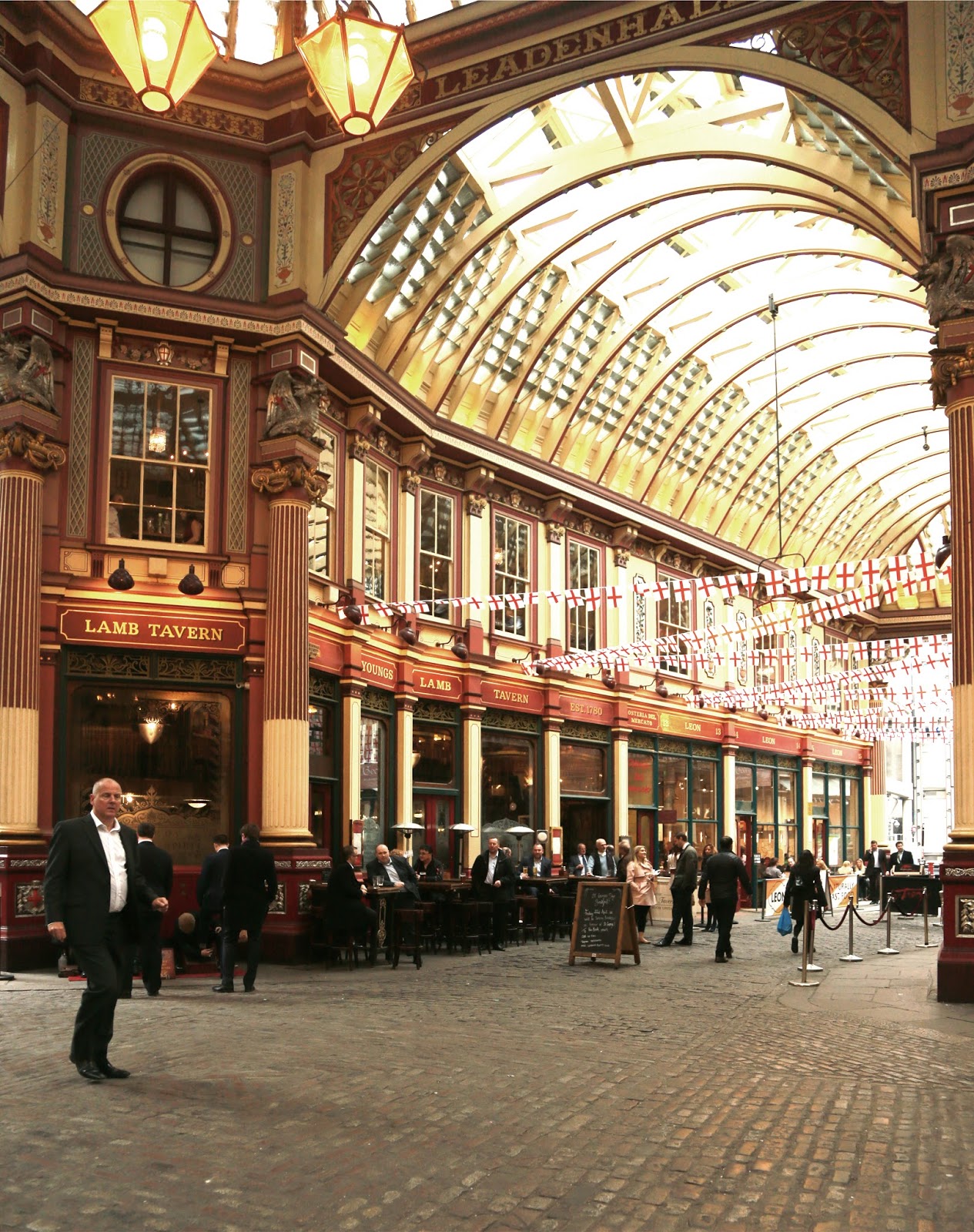
City of London, Leadenhall Market, Contemporary Architecture and Monument

Leadenhall Market dates from about the 14th century, although this luxurious architecture was erected in 1881.
The hustle and bustle of markets such as that at Camden is missing from this, which is more like a classy arcade.
The beautifully designed architecture of the 1881 version of Leadenhall market provided a lovely subject for Gary's photographic interests.
Having started out as a market for meat, cheese, fish, and other foodstuffs, this Leadenhall market is more a meeting place for London trendies who enjoy watching the world go by, over their cafe lattes and fine wines.
There was one flower stall in the Leadenhall market, while all the rest of the sales areas were within actual shops, selling clothing (e.g., specialising in ties, or scarves, or hats), fine eating andrefreshments of various kinds).
As we walked from Leadenhall market back to the Monument tube station, we passed 20 Fenchurch Street, one of the modern notable architectural delights that has been nicknamed the 'walkie talkie'.
Also between Leadenhall market and Monument tube station we suddenly saw the 'Shard' in a misty sky beyond much older buildings.
Gary is very interested in the use to which stainless steel has been put in modern architecture, and so was delighted to suddenly be confronted by walls reflecting other colours as we passed down a laneway.

The Monument can be seen at the entrance to Monument tube station, in remembrance of the Great Fire of London of September 1666. Starting in a bakery in Pudding Lane, it burnt 13,200 houses, 87 churches, and St Paul's Cathedral, in three days of continuous burning, destroying all of the old City of London.

Thursday, 7 April 2016

Tower of London

Andy took this photograph of Tower Bridge, viewed from an archway in the wall of the Tower of London.
Joan and Andy are standing in front of the White Tower, the keep of the Tower of London, built in 1080s by William the Conquerer.
Andy took this image of Gary and Joan, in the rain and cold at the Tower of London.
The queue waiting to go into the Jewel House at the Tower of London, on a cold, wet and windy day.

Armed royal guards on duty outside the Jewel House at the Tower of London.
The Crown Jewels are displayed in this fine building that has state of the art security.
Andy walking in the grounds of the Tower of London, taking in the historic atmosphere.
The display of armour in the White Tower, the 1080s keep of the Tower of London, where tourism started early. Apparently visitors have been coming to see this display since the 1600s.
The second floor of the White Tower houses an impressive display of armour since the time of Henry VIII, such as these breastplates.
A full wall of breastplates on display. There were amazing suits of armour, including beautifully decorated ones made for children, such as princes aged as young as five years.
The caption above describes the remains of the wall from the time of Roman London.

This caption relates to the next image, regarding the cannon on display outside the White Tower.

Many of the staff at the Tower of London, including the "beefeaters", live in the lovely homes built over the centuries within the grounds of the Tower, which has been both a fortress and a royal palace.

Wednesday, 6 April 2016

Camden Market

Having now become a cadet photographer, Andy took this photo of Gary and Joan at the cafe in Camden Town, where we ate deep fried chicken with waffles and maple syrup - most unusual, but entirely edible! The cafe was called the "Bird".
Opposite the "Bird" was an entrance into Camden Market, and just inside the gate was this initial taste of the wonders of the market.
A shoe display in a window at the market showed some quite amazing women's shoe styles.
Gary, Andy and I walked across the several bridges over the waterways of Camden, and peered down at the various food stalls displaying their wares - foods from the Netherlands, Malaysia, Argentina, Venezuela, India, Vietnam, China: you name it, they had it. What a variety!
This large weeping willow softened the effects of the bustling array of market stalls beside the canal.
"Belly and bao" revealed a stall selling those lovely Chinese buns filled with pork, next to Columbian street food, beside Argentine steak and burgers. The food was worth the visit to Camden Market, let alone all the other wonders.
This stall advertised smoothies of fruit and vegetables, including mango crush and watermelon bliss.
Canal boats floating in Camden lock can be seen behind the Indian food stall and squeezed orange juice drinks.
This fresh coconut water stall claimed it to be a cure for a hangover.
Looking down from a walkway overlooking the stalls we were enticed by the Brazilian sweets displayed for sale.
Gary stitched together three images to make this wide-angled view of Joan overlooking the colourful food stalls at the Camden market.

Tuesday, 5 April 2016

Hampton Court Palace

At Hampton Court Palace we got caught up in a re-enactment of the case against Thomas Culpeper and Henry VIII's Queen Catherine Howard, and (believe it or not!!) Joan was chosen to act as one of the questioners against Culpeper. That's me in the centre, seated, as a member of the King's court. I had to ask: "Master Culpeper, My Lord the Duke of Norfok informs us that he has received report that you have been with the Queen five or six times in secret and suspect places, among others at Lincoln, where you were closetted together five or six hours. Is this true?" The act involved a number of members of the audience, including children, who did a great job. Of course, the result was that Queen Catherine, Thomas Culpeper, and Lady Rochford were all put to death, and the re-enactment made it all seem very real.
The Great Hall is the largest room in Hampton Court Palace, built in the 1530s for Henry VIII, but restored in the 1840s. It is 32 metres long, 12 metres wide, 18 metres high, an has a musician's gallery at one end.
The hammer-beam ceiling is most impressive, and the wood is decorated in red, blue and gold paint.
Thomas Culpeper at left, Lady Rochford (Mary, the widowed sister-in-law of Anne Boleyn), with a court guard at right, watched by the audience who were playing the parts of members of the King's court.
Samples of some of the golden plate that made up King Henry VIII's dinner ware.

One of the laneways at Hampton Court Palace, leading from a courtyard towards the kitchens.
Two cooks turning the spit to roast joints of beef in the 500 year old kitchens that at that time produced 1500 meals per day for Henry's court members and their staffs and guests. These actors told us that this is the oldest cooking apparatus still being used in England, exactly as it was in the 1500s.
Joan is walking from one passageway in the old palace into another leading to the network of great kitchens where massive amounts of food were prepared daily to feed the vast numbers of courtiers.
Gary took this image of part of the wine cellars next to the kitchens at Hampton Court Palace.
A group of musicians in the courtyard  played instruments that were common in England during the 1500s.
Gary took this photograph from a window of the palace, looking over one small part of the magnificent gardens at Hampton Court Palace. In one section there is a maze, that Andy easily defeated by finding his way through without coming to a dead end.
150 years after Henry VIII the palace was owned by William III (William of Orange, the Dutch prince who married Mary II of England). Mary and William were joint monarchs, and made great changes to parts of Hampton Court Palace, through Christopher Wren's designs of baroque-style apartments.
A courtyard surrounded by the oldest surviving buildings of Hampton Court Palace, dating from about 1514 when Thomas Wolsey purchased Hampton Court when it was just a manor house built after about 1494. Wolsey gained great power and wealth as King Henry VIII's indispensable administrator, and was made a cardinal. He made the whole complex into a luxurious palace.
Gary photographed Joan walking in the long covered gallery that allowed King William III and his Queen Mary II to walk during rainy weather, and was also used as an orangery.
The Great Fountain Garden was formerly part of Henry VIII's hunting park, but became an elaborate formal garden with yet trees and holly globes, gravelled avenues and thirteen fountains.
Gary's great hope of photographing an expanse of spring flowers was realised at Hampton Court Palace.
Daffodils, jonquils and bluebells make a beautiful splash of colour in the area of the gardens known as 'The Wilderness'.
Jonquils growing freely under the trees in 'The Wilderness'.
Springtime blossoms starting to appear on the trees throughout 'The Wilderness'.